
Geach Dental

Correcting The Black Border At The Gumline Of Crowns – Before And After

undefined

Dental crowns, commonly known as dental caps, are invaluable  restorations for rebuilding damaged or decayed teeth. These restorations offer both strength and aesthetic benefits, making them a popular choice among patients seeking to regain their confident smiles. However, in some cases, individuals may be left with a “black border” at the gumline of their crowns.

This disheartening occurrence manifests as a noticeable dark line where the crown meets the gum tissue. In our comprehensive guide, we will explore the reasons behind this unsettling phenomenon and shed light on the various professional prosthodontic solutions to rectify this problem. Akin to flipping a before-and-after switch, the transformation achieved by addressing black borders can be remarkable.

A black border at the gumline does not merely affect the visual appeal of your smile; it can also signify underlying dental concerns. Neglecting this issue may lead to gum health problems and jeopardize the longevity of your dental restoration. It is essential to understand the root causes, the diagnostic process, and the treatment options available to correct black borders.

Join us as we explore the intricacies of black borders on dental crowns and explore real-life, transformative before-and-after scenarios guided by the expertise of our prosthodontist. Read on to learn more!

Causes of Black Borders

Poor Marginal Fit

undefined
  • Patient-specific Fitting: Each patient’s dental anatomy is unique. If a crown is not custom-fitted accurately to the patient’s tooth, it can create gaps where bacteria can infiltrate. Over time, this poor marginal fit can lead to the development of a black border. See the black border in the picture above. 
undefined
  • Inadequate Restoration: Insufficiently sealed margins between the crown and the tooth can allow oral fluids and debris to penetrate, causing discoloration and decay. Ensuring a precise, snug fit is essential to prevent black borders. 

Gum Recession

undefined
  • Natural Aging Process: As patients age, gum recession is a common occurrence. Receding gums expose the underlying tooth structure and the crown’s margin, which can create the appearance of a black border. See picture above. 
  • Periodontal Conditions: Certain gum diseases and conditions can accelerate gum recession. Patients with periodontal issues are more susceptible to black borders around their crowns.

Aging Crowns

  • Wear and Tear: Older dental  crowns can deteriorate over time due to wear and  chipping. As the crown ages, the materials used may degrade, leading to the emergence of black borders.
  • Outdated Materials: Older crown materials may be more prone to developing black borders. This is due to the metal that shows at the border of the crown at the gum line. We no longer use dark metals in crown restorations, which greatly improves the dental aesthetics of the crown. 

Understanding these causes is the first step towards effectively addressing and resolving black border issues in dental crown patients.

Diagnosis and Evaluation

Clinical Examination

  • Visual Inspection: A skilled prosthodontist conducts a thorough visual examination of the patient’s oral cavity. This examination includes scrutinizing the crown’s margin, gumline, and adjacent teeth to identify any black border or related issues.
  • Checking Fit: The prosthodontist may use an explorer to assess the crown’s fit and check for any irregularities along the gumline. The periodontal health around the tooth will also be determined and periodontal probe will be used to check for any deep pockets. 

X-rays and Imaging

  • X-rays: Dental X-rays are essential for a comprehensive assessment. They provide insight into the crown’s fit. X-rays can show gaps or open margins where the crown meets the tooth. X-rays also show the health of the root and any periodontal bone loss.
  • Intraoral Scans: 3D intraoral scans are now used instead of uncomfortable impression materials. These scans create precise 3D images, allowing prosthodontists to visualize the shape of the crown and to evaluate the occlusion or biting surfaces.

Treatment Planning

  • Customized Solutions: Based on the clinical examination and imaging results, the prosthodontist develops a personalized treatment plan. This plan outlines the most suitable method to address the black border, taking into account the patient’s specific case.
  • Discussion with the Patient: The prosthodontist communicates the diagnosis and treatment options to the patient, ensuring they understand the recommended course of action and actively participate in decision-making.

A meticulous diagnosis and evaluation process is vital for successfully identifying the causes of black borders and determining the most effective treatment strategy for each patient.

Treatment Options

Crown Replacement

undefined
  • Customized Crowns: In cases where the existing crown is the root cause of the black border, prosthodontists may recommend a new, precisely fitted crown. This ensures a snug fit and eliminates the risk of future black borders. See case 1 above. 
  • Material Advancements: Modern crown materials offer superior aesthetics and longevity.  All ceramic crown materials such as zirconia are used, for natural-looking and durable results. Having an in-office laboratory technician, where our crowns are fabricated in our office allows us to achieve excellent aesthetic results that match your surrounding teeth. 

Gingival Reshaping

  • Surgical Procedure: Gingival reshaping, or gum contouring, involves a minor surgical procedure to adjust the gum line. By reshaping the gums to the appropriate level, we can create better harmony and improve the proper aesthetic tooth proportions. New crowns are often needed in conjunction with this surgical procedure to hide the black borders.  

Porcelain Veneers

  • Thin, Aesthetic Facings: Porcelain veneers are thin ceramic facings that are custom-made to cover the front surface of teeth. They can effectively mask black borders, providing a natural and aesthetically pleasing outcome.
  • Minimally Invasive: Veneers require less tooth reduction, helping to preserve the underlying tooth structure.

Composite Bonding

  • Resin Application: Composite bonding involves the application of tooth-colored resin to cover the black border area. This resin is skillfully shaped and polished to match the surrounding tooth structure.
  • Cost-Effective: Bonding is a cost-effective solution for concealing black borders and enhancing the crown’s appearance.

Prosthodontists employ these treatment options with precision and expertise, tailoring the approach to each patient’s unique circumstances and preferences. Treatment choice depends on factors such as the cause of the black border, the patient’s oral health, and their aesthetic goals.

Recovery and Aftercare

Post-Treatment Care

  • Follow Professional Guidance: After any dental procedure, it’s vital to adhere to the specific instructions provided by your prosthodontist. This may include dietary restrictions, oral hygiene practices, and medication as needed.
  • Monitor Symptoms: Pay attention to any symptoms such as lingering tooth sensitivity and report any concerns or complications to your prosthodontist promptly.

Long-Term Maintenance

  • Regular Dental Check-ups: Scheduling routine dental appointments is crucial for monitoring the health of your crown and gums. Your prosthodontist can detect any issues early and address them promptly.
  • Oral Hygiene: Maintain excellent oral hygiene by gentle brushing, flossing, and using mouthwash as your prosthodontist recommends. A clean and healthy mouth can reduce the risk of future black borders.
  • Avoiding Risk Factors: Be mindful of habits that can contribute to black borders, such as smoking or excessive force on your teeth. Minimizing these risk factors can help preserve your dental restoration.

By following a comprehensive post-treatment care plan and committing to long-term maintenance, you can ensure the longevity and aesthetics of your dental crown while preventing the recurrence of black borders. Your prosthodontist will guide you through the steps to keep your smile healthy and beautiful.

Summary

The presence of a black border around your dental crown can significantly mar your smile’s appearance and erode your confidence. Geach Dental, with two convenient locations in Downtown Los Angeles and Laguna Niguel, Orange County, specializes in resolving this issue. Our prosthodontic team will use advanced knowledge, specialized expertise, and cutting-edge technology to ensure you regain the attractive and confident look you deserve.

We are dedicated to providing every patient with tailored treatment in a comfortable environment. Our commitment includes comprehensive consultations to ensure you fully understand the procedure, its potential challenges, and the rewards it offers. Your satisfaction and comfort are our top priorities.

To take the first step toward eliminating the black border and achieving a healthier, more attractive smile, contact us today at (213) 622-3339  or click here to schedule a consultation. Geach Dental is your trusted partner on the journey to a more radiant and confident smile.

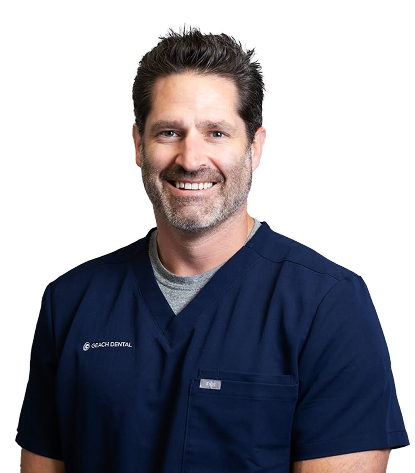
ABOUT THE AUTHOR: Meet Dr. Adam Geach, distinguished prosthodontic specialist and owner of Geach Dental. His dental education includes Harvard School of Dental Medicine and the University of Connecticut, where he earned a D.M.D. and an M.D.Sc. in Prosthodontics, respectively. Dr. Geach holds Diplomate status with the American Board of Prosthodontics, underscoring his exceptional expertise in dental care. 

At his clinics in Los Angeles and Laguna Niguel, Dr. Geach offers a wide range of services, from cosmetic treatments to full-mouth reconstructions, all delivered with a focus on personalized patient care.Take the first step toward your ideal smile and improved oral health by clicking here.

Search for Blog Articles

Pinteresting Board
Share

Meet Dr. Adam Geach, distinguished prosthodontics specialist and owner of  Geach Dental. 

His dental education includes Harvard School of Dental Medicine and the University of Connecticut, where he earned a D.M.D. and an M.D.Sc. in Prosthodontics, respectively. Dr. Geach holds Diplomate status with the American Board of Prosthodontics, underscoring his exceptional expertise in dental care. At his clinics in Los Angeles and Laguna Niguel, Dr. Geach offers a wide range of services, from cosmetic treatments to full-mouth reconstructions, all delivered with a focus on personalized patient care.Take the first step toward your ideal smile and improved oral health by clicking here.

Related blog posts

When Old Veneers Make Your Smile Look Older

A Prosthodontic Approach to Replacing Aging Cosmetic Dentistry with Natural-Looking Restorations If you had veneers or crowns placed 10, 15, or even 20 years ago, you may have loved your smile when they were first completed. But smiles change—and so does cosmetic dentistry. Older veneers can look bulky, square, opaque, worn, or simply outdated compared with today’s more natural-looking ceramic restorations. Sometimes patients don’t want an entirely new smile. They just want their smile to look natural again. That was the goal for this patient. The Problem: Old Veneers That No Longer Looked Natural This patient was referred to Geach Dental because she was unhappy with the appearance of her four upper front teeth. Her existing veneers had several characteristics that made them stand out from her surrounding natural teeth. The front teeth appeared very square, all four restorations slanted slightly to one side, and the porcelain was relatively opaque rather than having the subtle translucency of natural enamel. See picture below.  The veneers weren’t simply “old.” They looked like dental work. Our goal was to change that. We wanted to replace the aging restorations with teeth that blended naturally into her smile—without creating an artificial or overly perfect appearance. Good Cosmetic Dentistry Shouldn’t Look Like Dental Work One of the misconceptions about cosmetic dentistry is that improving a smile simply means making teeth whiter. For us, natural-looking cosmetic dentistry is much more about the details. The shape, proportions, contours, translucency, alignment, and color of the teeth all need to work together. For this patient, our goals were to: Ultimately, people should notice your smile—not your dental work. Designing the New Smile Before Making the Final Teeth Before fabricating the final restorations, we created a digital diagnostic design for the four front teeth. This allowed us to establish the new tooth shapes and proportions before completing the final crowns. After removing the existing veneers, the teeth were conservatively prepared and custom temporary crowns were made from our new digital design. This is an important part of our approach to complex cosmetic dentistry. Rather than simply removing the old restorations and hoping the patient likes the final result, the temporary crowns allow us to test-drive the new smile first. The Patient Gets a Say in the Final Smile With the temporary restorations in place, the patient can see the proposed changes directly in her own mouth. We can evaluate: Most importantly, the patient can give us feedback. If we want a tooth slightly shorter, longer, softer, or more rounded, those changes can be made before the final restorations are fabricated. Once the temporary restorations look and feel right, they become the blueprint for the final teeth. That patient feedback and refinement process was an important part of this case. Why Replacing Only Four Front Teeth Can Be So Challenging You might assume that replacing four veneers is easier than restoring an entire smile. Esthetically, the opposite can sometimes be true. When we replace only a few front teeth, the new restorations must blend with the patient’s remaining natural teeth. The shade can’t simply be “white.” Natural teeth have subtle variations in color, translucency, texture, and brightness. Reproducing those characteristics is what helps a ceramic restoration look like a tooth rather than a crown. The goal is not to make four beautiful crowns. The goal is to make it difficult to tell which four teeth are crowns. The Advantage of Our In-Office Dental Laboratory At Geach Dental, we work closely with our in-office laboratory technician when creating highly esthetic restorations. This allows us to carefully control details such as: In this case, the final restorations were designed, milled, characterized, and finished in close collaboration with our technician, using the refined temporary crowns as the guide for the final result. For front teeth, these small details can make an enormous difference. The Result: A More Natural-Looking Smile The objective wasn’t to give this patient a completely different smile. It was to make her existing smile look more natural, balanced, and current. The new front teeth have softer contours, improved alignment, and a more natural relationship with the surrounding teeth. The final crowns were made from zirconia, selected to provide a combination of esthetics and durability. The improvement is noticeable. But ideally, the dentistry isn’t. That’s exactly what we want. Before After Is It Time to Replace Your Old Veneers or Crowns? Many patients assume they should only replace veneers or crowns when something breaks. That’s not necessarily the case. You may want to consider replacing older cosmetic dental work if your restorations have become: You may also simply feel that your dental work makes your smile look older than you feel. In some cases, replacing just a few aging restorations can refresh the appearance of the entire smile. Why See a Prosthodontist for Replacing Old Dental Work? Replacing existing cosmetic dentistry presents different challenges than starting with untouched teeth. The dentist needs to evaluate the existing restorations, the teeth underneath them, the bite, the surrounding natural teeth, and the patient’s overall smile before determining what should—and just as importantly, what should not—be changed. A prosthodontist receives advanced specialty training in restorative, cosmetic, implant, and reconstructive dentistry. At Geach Dental, we routinely treat patients with existing veneers, crowns, dental implants, and complex restorative dentistry. Our approach isn’t simply about making teeth look prettier. We want the final restorations to look natural, function properly, and integrate with the rest of the patient’s smile. Ready to Update Your Smile? If you had cosmetic dentistry completed years ago and your veneers, crowns, or implant restorations no longer look the way you want, you may not need to start over. Sometimes the right approach is simply to replace aging dental work with modern, natural-looking restorations. Dr. Adam Geach, DMD, MDSc, is a prosthodontist providing advanced cosmetic, restorative, and implant dentistry at Geach Dental, serving patients in Downtown Los Angeles and Orange County. If you’re unhappy with old veneers, crowns, or other cosmetic dental work, schedule a consultation

Read Up

Replacing Old Crowns, Veneers and Dental Implant Restorations for a Natural, Younger Smile

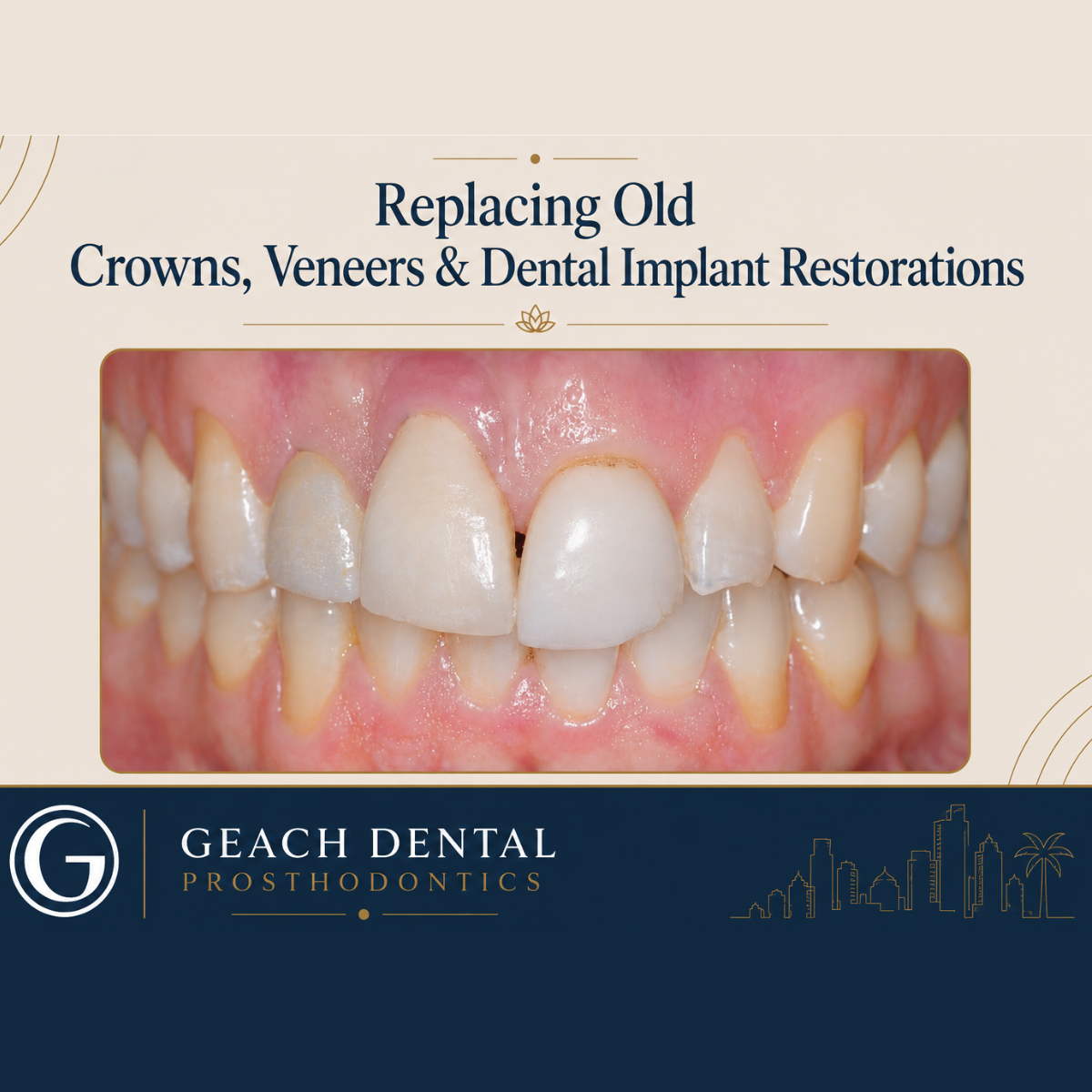
When Old Dental Work Makes Your Smile Look Older Even the highest-quality dental work doesn’t last forever. Over time, crowns, veneers and implant restorations can begin to show their age. They may chip, stain, or no longer match your surrounding teeth. As your gums naturally change over the years, restorations that once looked beautiful can begin to appear uneven or unnatural. Many patients tell us: This patient came to Geach Dental looking for exactly that. The Challenge This patient had several cosmetic concerns affecting the upper front teeth: Because the implant could not simply be moved, restoring this smile required careful planning and advanced prosthodontic expertise rather than simply replacing the crowns.  Why Replacing Old Dental Work Isn’t Always Simple Many people assume replacing an old crown or veneer is straightforward. Unfortunately, that’s not always the case. When dental implants, veneers, crowns and natural teeth all need to work together, every small detail matters: These complex cases are exactly why prosthodontists receive years of additional specialty training after dental school. Our Treatment Process Rather than immediately making new crowns, we first removed the existing restorations to evaluate the health of the underlying teeth and assess the position of the dental implant. Using digital smile design principles, we created custom provisional (temporary) restorations that allowed us to: These temporary restorations became the blueprint for the final result. Precision Craftsmanship Makes the Difference One advantage unique to Geach Dental is our in-office dental laboratory. Instead of sending everything to an outside lab, Dr. Adam Geach works directly with an experienced laboratory ceramist to customize: This close collaboration allows us to achieve an exceptional level of detail that is especially important in the highly visible front teeth. The Final Result Although the original implant position limited how much the gum line could be changed, nearly every other esthetic concern was corrected. The new restorations provided: The result is a smile that looks healthier, more balanced and significantly more natural. Healthy implant and tooth structure formed first: Final Restorations Placed: Do You Have Old Crowns, Veneers or Dental Implant Restorations? You may be an excellent candidate for replacing your existing dental work if you notice: Many patients are surprised how dramatically replacing aging dental work can refresh their entire appearance. Why Choose a Prosthodontist? Replacing cosmetic dental work is about much more than making new crowns. A prosthodontist is a dental specialist trained in complex restorative, cosmetic and implant dentistry. This advanced training is especially valuable when treating challenging cases involving: At Geach Dental, every smile is carefully planned with the goal of creating results that are beautiful, functional and built to last. Schedule a Smile Consultation If your crowns, veneers or dental implant restorations are beginning to look worn, stained or outdated, we can help you achieve a natural-looking smile that looks healthy—not like dental work. Dr. Adam Geach, DMD, MDSc is a board-certified prosthodontist providing advanced cosmetic dentistry, smile makeovers and dental implant restoration in Downtown Los Angeles and Laguna Niguel, serving patients throughout Los Angeles County and Orange County. Contact Geach Dental today to schedule your personalized smile consultation.

Read Up

Follow Our Newsletter To Stay Tuned

Sign up to receive exclusive guides & tips on health, fashion, travel, beauty and more!

Follow Our Newsletter To Stay Tuned

Sign up to receive exclusive guides & tips on health, fashion, travel, beauty and more!