
Geach Dental

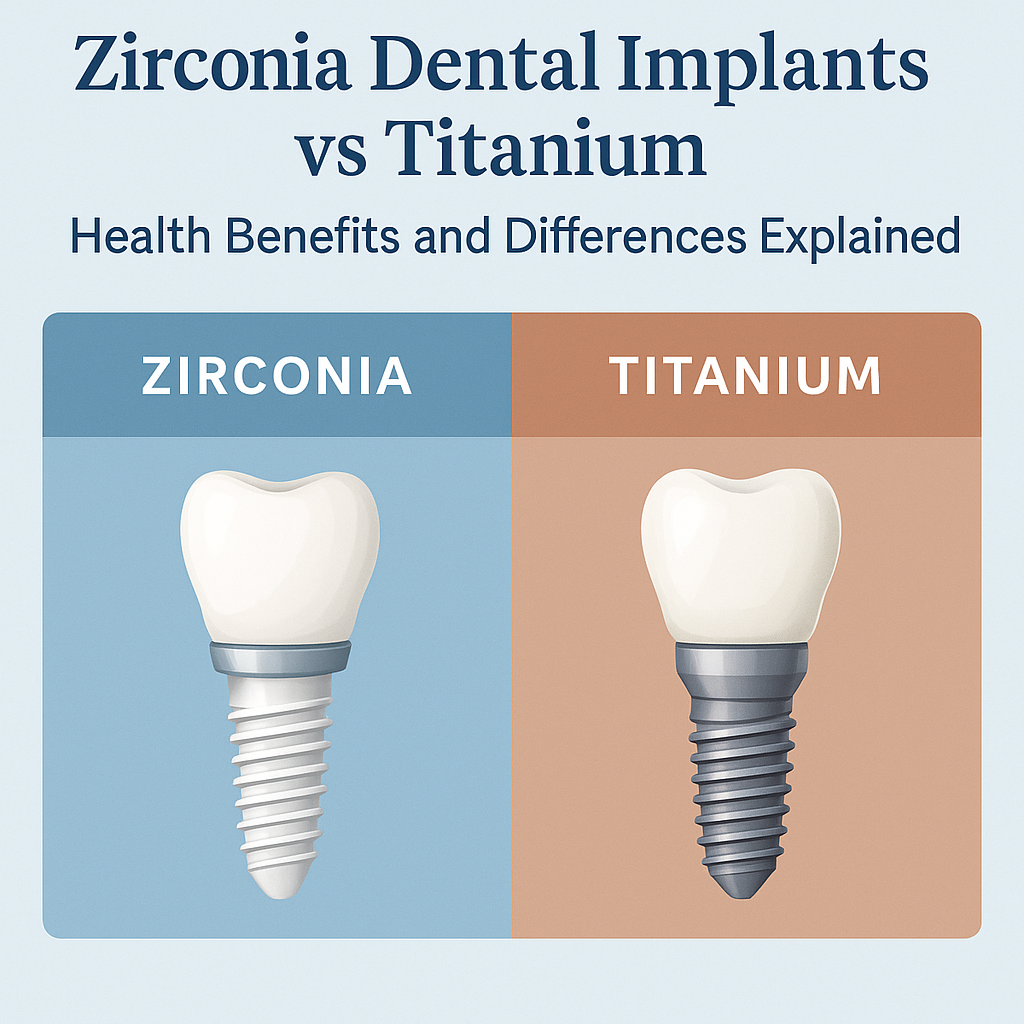
Zirconia Implants vs. Titanium: Health Benefits and Differences Explained

Dental implants have been a major advancement in replacing missing teeth. When placed correctly, titanium implants have incredibly high success rates and are the standard for tooth replacement. Dental implants can be used to replace a single tooth or can be strategically placed to support multiple missing teeth or a whole arch of teeth. The great benefit of dental implants is that they eliminate a removable denture and provide the function and appearance of natural teeth. 
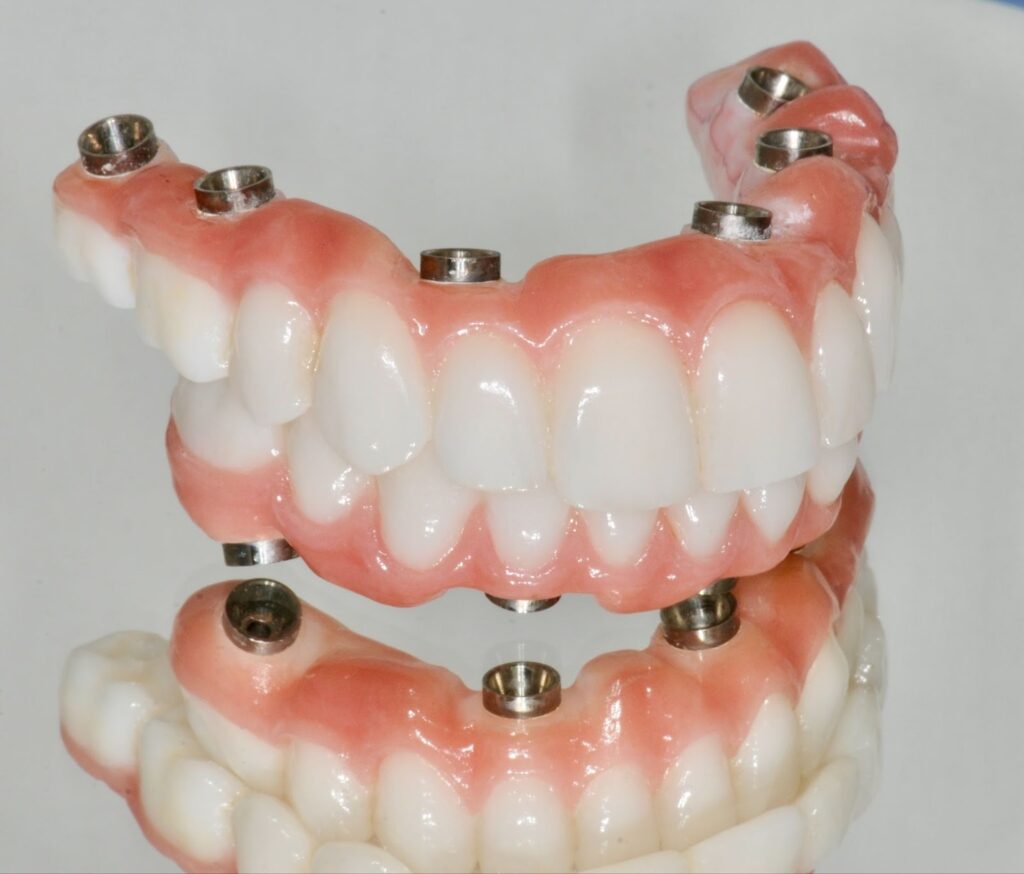
Over the past couple years, patients have become concerned about the idea of having metal titanium implants placed in their body. Some patients are not comfortable with the idea of having a “foreign metal object” placed into their jawbone. I can understand their concern especially if they are unsure of the science, materials used and potential risks. So much information is available on the internet and it is difficult to find answers to these questions. Because of this, some patients are more comfortable with the idea of non-metal zirconia implants as an alternative. So, are zirconia dental implants healthier than titanium dental implants? 

Composition of titanium dental implants

Titanium (Ti) is a metallic element with the atomic number 22 and has a silvery color. It is the ninth most abundant element in the earth’s crust. The alloy Ti-6Al-4V (Titanium, 6-aluminum, 4-vanadium), which was originally used for aerospace applications, is currently the most frequently used material for medical and dental implantation. Titanium alloys are widely used for orthopedic implantation (joint replacements) because of their lightweight, high biocompatibility and favorable strength/density ratios. Titanium alloys are superior to stainless steel and cobalt-chrome (Co-Cr) alloys with regard to biocompatibility and corrosion resistance. 

Titanium plays a pivotal role for dental implants because the roughened surface of these implants attract bone cells to deposit bone and fill the space between the jawbone and the implant surface. This process is called osseointegration and is critical for implant stability. Titanium dental implants quickly form a layer of titanium dioxide on the surface and this layer forms a boundary between the metal surface and the body, preventing corrosion and deterioration of the material. This is the reason for the high biocompatibility. 

Can titanium dental implants cause an allergic reaction? 

Exposure to titanium from implants is common, but reports on clinical allergy are rare. Titanium dioxide on the surface of dental implants is more stable than pure titanium. It is possible that titanium ions could be released from the surface and sometimes into distant tissue. However, evidence for the possible toxic effects and risk of allergic reactions is weak (1). One study showed that titanium allergy can be detected in dental implant patients, even though its estimated prevalence is very low (0.6%) (2). It should be noted that no material, including any dental implant, can be considered universally biocompatible. As mentioned above, the Ti-6Al-4V alloy is the preferred choice for dental implants. Small amounts of other elements associated with titanium alloys can act as “impurities.” Titanium alloys can contain very small amounts of beryllium, cobalt, chromium, copper, iron, nickel and palladium. These impurities may be causative factors for different allergic reactions in patients with dental implants, but the likelihood is low. 

It is therefore advisable to test for titanium allergy in patients with a history of multiple and/or severe allergies. These include allergy to jewelry, nickel and cobalt. Furthermore, patients with previous unexplained implant failure could be tested. In the rare situation that a patient is allergic to titanium, it is preferable to use alternative treatment options or to use an alternative dental implant material such as zirconia (3). 

What are zirconia implants? 

The idea of an alternative to titanium dental implants has been growing for years due to the questions regarding sensitivity to titanium that was discussed above. Another drawback of titanium is its grey color. When a titanium implant is placed in an area with very thin gingival tissue, there is a risk that a dark grey shadow may be visible. 

Zirconium dioxide (zirconia) has been introduced as an alternative to titanium dioxide. Zirconia was first used for the fabrication of dental crowns and implant abutments. Currently, tetragonal zirconia poly-crystal is the ceramic of choice for dental implants. The white, opaque color of zirconia along with the good biocompatibility, favorable mechanical properties and low affinity for bacterial plaque, make it a good potential material for dental implants. 

Are zirconia implants as successful as titanium implants? 

Osseointegration is a major factor in the success of modern dental implants. Titanium remains the material of choice for obtaining and maintaining osseointegration. Early studies show that zirconia implants have similar 1 and 2 year survival rates when compared to titanium implants. More clinical long-term studies providing detailed information about implant failures, biological and technical complications, and prosthetic and esthetic outcomes are urgently needed (3).

Potential implant abutment and crown complications

Once a dental implant has integrated and healed with the jawbone, an implant abutment and crown are then made to complete the replacement of the tooth. The abutment and crown is held into the implant by a screw. These 3 components are shown in the picture below.  
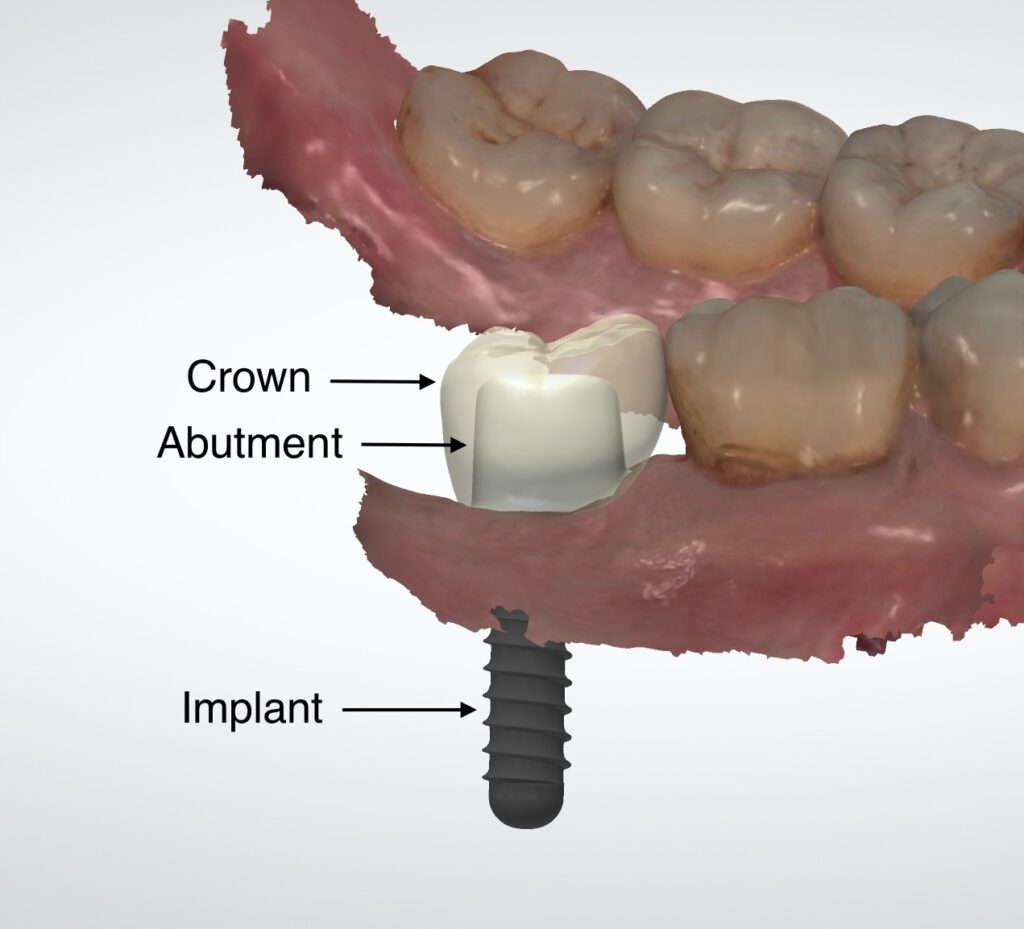
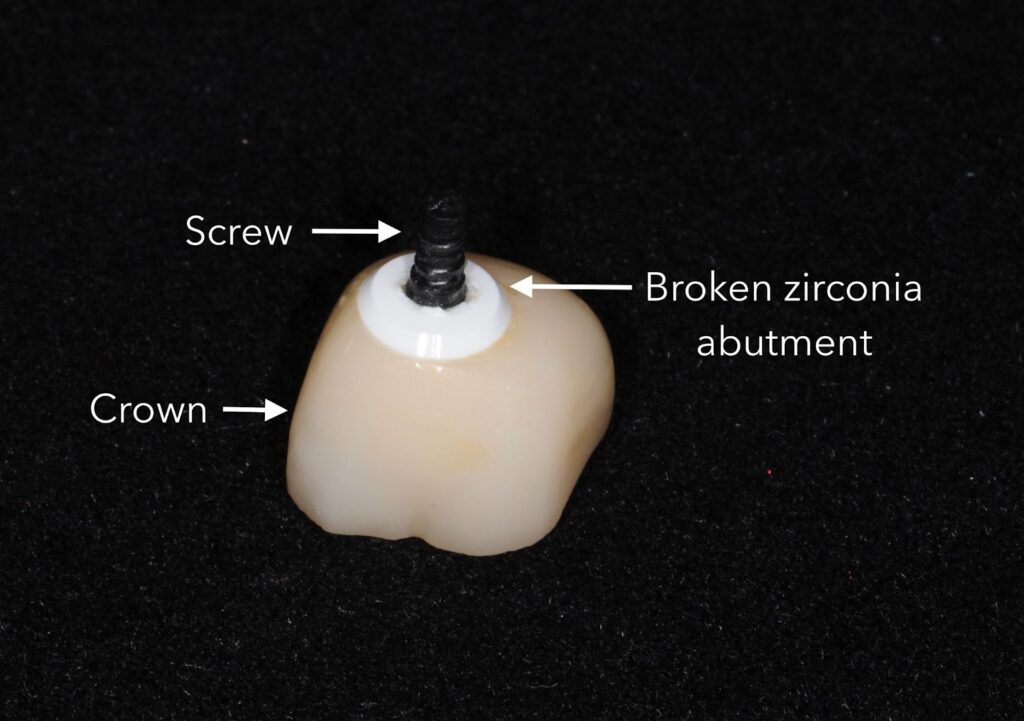
When titanium is used for the implant and abutment, this connection is incredibly strong and stable with very few mechanical complications from chewing. On the other hand, zirconia is a more brittle material compared to titanium. When zirconia is used for the implant and abutment, more mechanical complications (breakage of the abutment) have been reported, see picture below. This has been reported in studies and I have also experienced this in my practice. The challenge with zirconia is the strength and stability of the connection between the abutment and implant. So far, this connection is not as reliable as titanium. When implant abutments break, this expensive abutment and crown needs to be replaced and has the possibility of breaking again.  
Conclusions

  • Titanium is still the material of choice for dental implants and the replacement of missing teeth. Long term studies demonstrate very high success rates for this treatment. 
  • Exposure to titanium could cause an allergic reaction but the likelihood is very low. The estimated prevalence of titanium allergy in dental implant patients is less than 1%.
  • Zirconia is now used as a dental implant material for patients that might be concerned about a titanium allergy. Long term studies are needed to better understand the success, function and esthetic outcomes of zirconia implants. 
  • If zirconia implants are used to replace a missing tooth, the patient needs to be aware of the potential complications such as breakage of the implant abutment and crown. This leads to additional expense for replacement. 

References

  1. Fage S. et al. Titanium: a review on exposure, release, penetration, allergy, epidemiology, and clinical reactivity. Contact Dermatitis, 2016:74:323-345.
  2. Sicilia A. et al. Titanium allergy in dental implant patients: a clinical study on 1500 consecutive patients. Clin Oral Impl. Res, 2008:19:823-835.
  3. Singh R. et al. Prevalence of titanium hypersensitivity in patients with titanium implants: A systematic review and meta-analysis. Journal of Pharmacy and Bioallied Sciences, 2021:13(2):1345-1349.
  4. Roehling S. et al. Performance and outcome of zirconia dental implants in clinical studies: A meta-analysis. Clin Oral Imp Res, 2018:29(16):135-153.

At Geach Dental in Downtown Los Angeles and Laguna Niguel, Orange County our team has extensive experience in dealing with dental implant issues. If you are concerned about your dental implants or are considering having an implant placed, we encourage you to contact Geach Dental at (213) 622-3339, or click here to schedule a consultation. You deserve the best care. 

ABOUT THE AUTHOR: Meet Dr. Adam Geach, distinguished prosthodontic specialist and owner of Geach Dental. His education includes Harvard School of Dental Medicine and The University of Connecticut, where he earned a DMD and MDSc in Prosthodontics, respectively. Dr. Geach holds Diplomate status with the American Board of Prosthodontics, underscoring his exceptional expertise in dental care. 
Search for Blog Articles

Pinteresting Board
Share

Meet Dr. Adam Geach, distinguished prosthodontics specialist and owner of  Geach Dental. 

His dental education includes Harvard School of Dental Medicine and the University of Connecticut, where he earned a D.M.D. and an M.D.Sc. in Prosthodontics, respectively. Dr. Geach holds Diplomate status with the American Board of Prosthodontics, underscoring his exceptional expertise in dental care. At his clinics in Los Angeles and Laguna Niguel, Dr. Geach offers a wide range of services, from cosmetic treatments to full-mouth reconstructions, all delivered with a focus on personalized patient care.Take the first step toward your ideal smile and improved oral health by clicking here.
Related blog posts

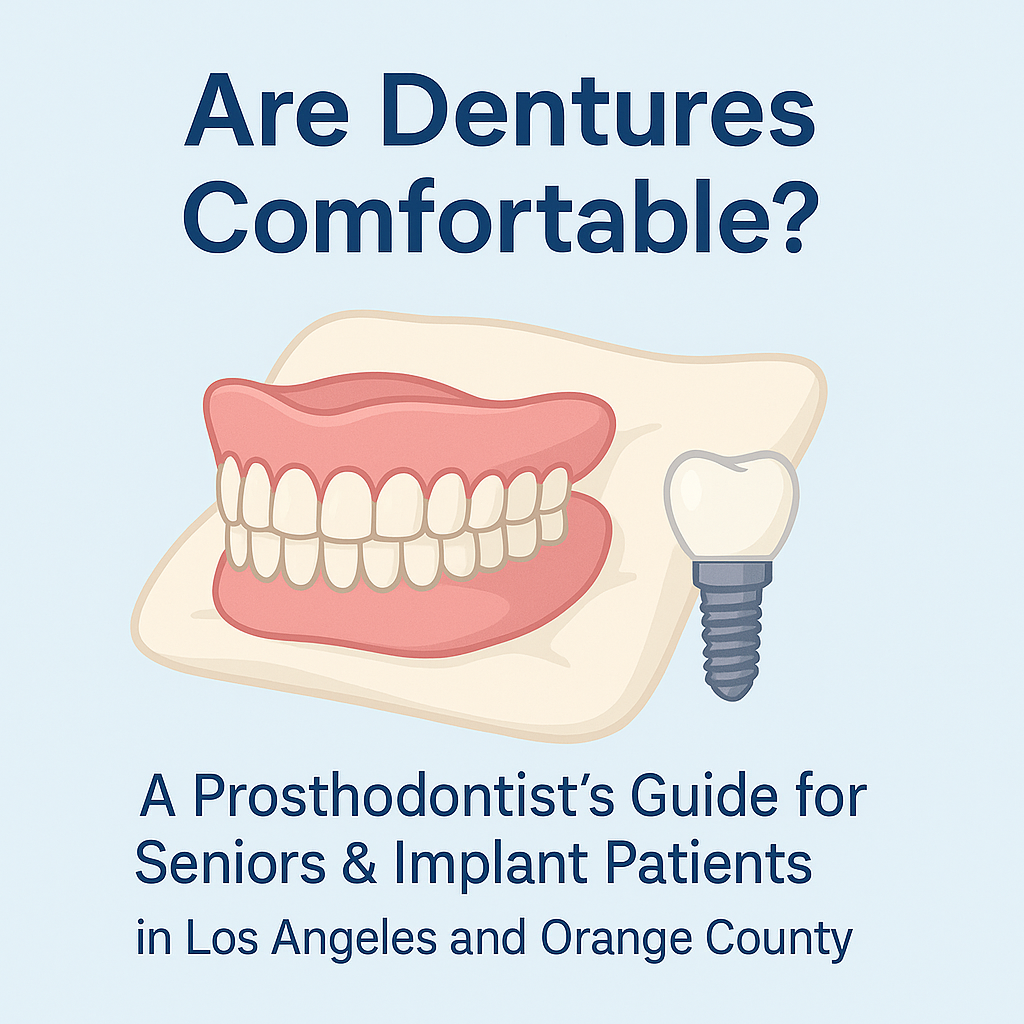
Are Dentures Comfortable? A Prosthodontist’s Guide for Seniors & Implant Patients in Los Angeles and Orange County

If you’re missing teeth and considering dentures, one of the most common questions seniors and implant candidates ask is: “Will dentures actually feel comfortable?” The good news is—yes, modern dentures can be very comfortable when they are custom-made, properly fitted, and supported by today’s advanced dental technology. For patients in Los Angeles and Orange County, especially seniors looking to restore their smile, chewing ability, and confidence, today’s denture and implant options offer far more comfort and stability than ever before. In this guide, you’ll learn: Types of Dentures Available in Los Angeles and Orange County Choosing the right type of denture plays a major role in comfort, function, and confidence. Below are the most common options recommended for seniors and patients that are missing teeth.  1. Complete Dentures Complete dentures replace all teeth in the upper or lower jaw. These removable appliances rest on the gums and rely on suction and fit for stability. Best for: Patients missing all teeth who want a less expensive, removable option.Comfort level: Good with proper fit, but may feel less stable over time due to natural bone loss. Material: Acrylic                                                                                                                    Adhesive use: Sometimes required 2. Removable Partial Dentures Partial dentures replace several missing teeth and attach to the remaining natural teeth using clasps. Best for: Patients who still have some healthy natural teeth.Comfort level: Good when properly designed, though clasps may take time to get used to. Material: Metal framework with acrylic. 3. Implant-Retained Dentures These dentures look similar to traditional removable dentures but are less bulky and snap onto dental implants for stability. Best for: Patients who struggle with loose dentures.Comfort level: Excellent – dramatically more stable than traditional dentures.                    Material: Metal framework is hidden for strength and wrapped with acrylic.                                                            Adhesive use: Not needed As few as two implants in the lower jaw and four in the upper jaw can significantly improve comfort and chewing efficiency. 4. Implant-Supported Dentures (All-on-4 / All-on-X) This is the most advanced tooth replacement solution available. A full arch of fixed teeth is supported by four or more implants and does not come out. Best for: Patients who want permanent, natural-feeling teeth.Comfort level: Highest – closest feel to natural teeth.Material: Zirconia ceramic for strength and esthetics. For many implant candidates, this option delivers the most life-changing results. What Makes Dentures Comfortable? Several key factors determine whether dentures feel comfortable or problematic. 1. Proper Fit Complete denture comfort begins with precise custom impressions and detailed shaping of the denture borders to match the movement of your lips, cheeks, and tongue. This technique is called border molding and helps prevent soreness, rubbing, and looseness. For partial dentures, proper planning and preparation of the supporting teeth ensures thinner appliances and more comfort for the tongue, cheeks and surrounding tissues. 2. Correct Bite Alignment (Occlusion) Occlusion refers to how your upper and lower teeth come together when you bite. If the bite is uneven, dentures can rock, rub the gums, and cause sore spots. A balanced bite greatly increases comfort and chewing ability. 3. Dental Implant Support For many patients, implants are the key to truly comfortable dentures. Implants: Lower dentures benefit the most from implant stabilization. The Adjustment Period: What Patients Should Expect When transitioning from natural teeth to dentures, an adjustment phase is completely normal and usually lasts a few weeks to a couple of months. During this time, you may experience: Tips for a Smoother Transition After extractions, your gums and bone continue healing for several months. Once fully healed, a final hard reline is performed to improve long-term comfort and fit. Denture Care & Maintenance for Long-Term Comfort Daily care is essential for both comfort and oral health.  1. Rinse after meals to remove food particles.2. Brush daily using a soft denture brush with mild soap (no toothpaste).3. Clean your gums and tongue with a damp cloth.4. Soak dentures overnight in water or a denture cleanser. 5. Never use hot water, bleach, or abrasive cleaners. 6. Visit your dentist yearly for fit checks and relines. Over time, jawbone changes can loosen dentures. Regular professional care prevents discomfort and instability. Common Denture Problems & Solutions Sore spots and irritationCause: Pressure or rubbing  Solution: Denture adjustment or reline Loose denturesCause: Bone shrinkage over timeSolution: Reline, remake, or add dental implants Difficulty chewingCause: New dentures or uneven biteSolution: Bite adjustment and dietary adaptation or remake dentures Difficulty speakingCause: Tongue adapting to new surfacesSolution: Speech practice and possible adjustment GaggingCause: Overextended denture baseSolution: Precision adjustment, add dental implants Unnatural appearanceCause: Poor tooth or gum contouringSolution: Remake and custom esthetic design Sunken facial appearanceCause: Bone loss without teethSolution: New dentures, add dental implants Are Implant Dentures Worth It for Seniors in Los Angeles and Orange County? For many seniors, implant-supported dentures are absolutely worth it because they: For patients seeking the most natural look and feel, All-on-4 or All-on-X solutions provide a permanent, fixed alternative to removable dentures. Frequently Asked Questions How long does it take to get used to dentures?Most patients adjust within a few weeks to a couple of months. Can dentures be worn at night?It is recommended to remove dentures at night to allow gums to rest and recover from daily use.  Are implant dentures permanent?Implant-supported bridges are fixed, while implant-retained dentures are removable but extremely stable. Do dentures hurt?Properly fitted dentures should not cause ongoing pain. Temporary soreness during adjustment is normal and treatable. How much do dentures cost in Los Angeles

Read Up

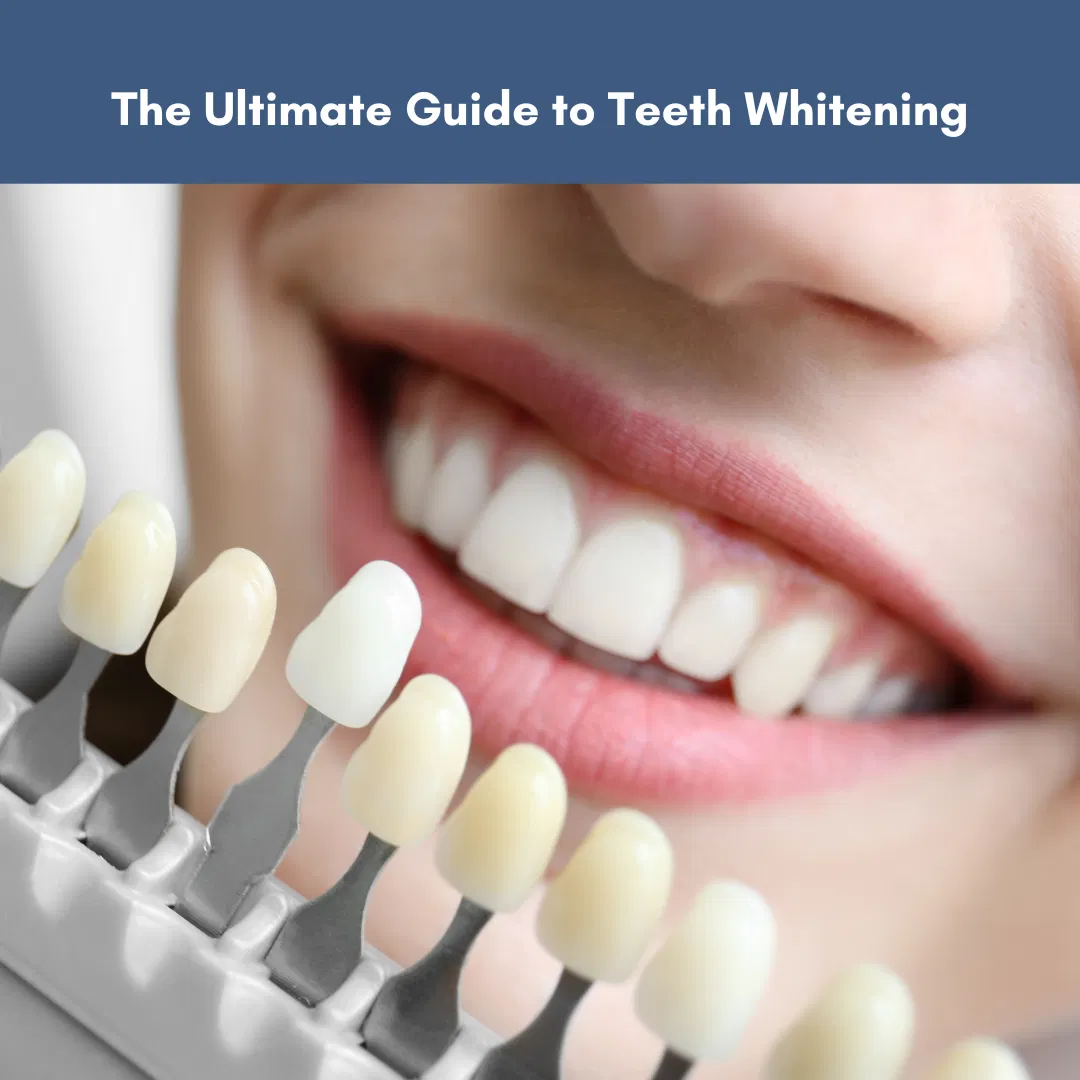
The Ultimate Guide to Teeth Whitening

Explore the ultimate guide to successful teeth whitening, covering professional vs. at-home treatments, personalized plans, in-office procedures, take-home kits, and essential aftercare tips. Read on to discover the path to a brighter, healthier smile with our expert insights.

Read Up

Are Dentures Comfortable? A Prosthodontist’s Guide for Seniors & Implant Patients in Los Angeles and Orange County

If you’re missing teeth and considering dentures, one of the most common questions seniors and implant candidates ask is: “Will dentures actually feel comfortable?” The good news is—yes, modern dentures can be very comfortable when they are custom-made, properly fitted, and supported by today’s advanced dental technology. For patients in Los Angeles and Orange County, especially seniors looking to restore their smile, chewing ability, and confidence, today’s denture and implant options offer far more comfort and stability than ever before. In this guide, you’ll learn: Types of Dentures Available in Los Angeles and Orange County Choosing the right type of denture plays a major role in comfort, function, and confidence. Below are the most common options recommended for seniors and patients that are missing teeth.  1. Complete Dentures Complete dentures replace all teeth in the upper or lower jaw. These removable appliances rest on the gums and rely on suction and fit for stability. Best for: Patients missing all teeth who want a less expensive, removable option.Comfort level: Good with proper fit, but may feel less stable over time due to natural bone loss. Material: Acrylic                                                                                                                    Adhesive use: Sometimes required 2. Removable Partial Dentures Partial dentures replace several missing teeth and attach to the remaining natural teeth using clasps. Best for: Patients who still have some healthy natural teeth.Comfort level: Good when properly designed, though clasps may take time to get used to. Material: Metal framework with acrylic. 3. Implant-Retained Dentures These dentures look similar to traditional removable dentures but are less bulky and snap onto dental implants for stability. Best for: Patients who struggle with loose dentures.Comfort level: Excellent – dramatically more stable than traditional dentures.                    Material: Metal framework is hidden for strength and wrapped with acrylic.                                                            Adhesive use: Not needed As few as two implants in the lower jaw and four in the upper jaw can significantly improve comfort and chewing efficiency. 4. Implant-Supported Dentures (All-on-4 / All-on-X) This is the most advanced tooth replacement solution available. A full arch of fixed teeth is supported by four or more implants and does not come out. Best for: Patients who want permanent, natural-feeling teeth.Comfort level: Highest – closest feel to natural teeth.Material: Zirconia ceramic for strength and esthetics. For many implant candidates, this option delivers the most life-changing results. What Makes Dentures Comfortable? Several key factors determine whether dentures feel comfortable or problematic. 1. Proper Fit Complete denture comfort begins with precise custom impressions and detailed shaping of the denture borders to match the movement of your lips, cheeks, and tongue. This technique is called border molding and helps prevent soreness, rubbing, and looseness. For partial dentures, proper planning and preparation of the supporting teeth ensures thinner appliances and more comfort for the tongue, cheeks and surrounding tissues. 2. Correct Bite Alignment (Occlusion) Occlusion refers to how your upper and lower teeth come together when you bite. If the bite is uneven, dentures can rock, rub the gums, and cause sore spots. A balanced bite greatly increases comfort and chewing ability. 3. Dental Implant Support For many patients, implants are the key to truly comfortable dentures. Implants: Lower dentures benefit the most from implant stabilization. The Adjustment Period: What Patients Should Expect When transitioning from natural teeth to dentures, an adjustment phase is completely normal and usually lasts a few weeks to a couple of months. During this time, you may experience: Tips for a Smoother Transition After extractions, your gums and bone continue healing for several months. Once fully healed, a final hard reline is performed to improve long-term comfort and fit. Denture Care & Maintenance for Long-Term Comfort Daily care is essential for both comfort and oral health.  1. Rinse after meals to remove food particles.2. Brush daily using a soft denture brush with mild soap (no toothpaste).3. Clean your gums and tongue with a damp cloth.4. Soak dentures overnight in water or a denture cleanser. 5. Never use hot water, bleach, or abrasive cleaners. 6. Visit your dentist yearly for fit checks and relines. Over time, jawbone changes can loosen dentures. Regular professional care prevents discomfort and instability. Common Denture Problems & Solutions Sore spots and irritationCause: Pressure or rubbing  Solution: Denture adjustment or reline Loose denturesCause: Bone shrinkage over timeSolution: Reline, remake, or add dental implants Difficulty chewingCause: New dentures or uneven biteSolution: Bite adjustment and dietary adaptation or remake dentures Difficulty speakingCause: Tongue adapting to new surfacesSolution: Speech practice and possible adjustment GaggingCause: Overextended denture baseSolution: Precision adjustment, add dental implants Unnatural appearanceCause: Poor tooth or gum contouringSolution: Remake and custom esthetic design Sunken facial appearanceCause: Bone loss without teethSolution: New dentures, add dental implants Are Implant Dentures Worth It for Seniors in Los Angeles and Orange County? For many seniors, implant-supported dentures are absolutely worth it because they: For patients seeking the most natural look and feel, All-on-4 or All-on-X solutions provide a permanent, fixed alternative to removable dentures. Frequently Asked Questions How long does it take to get used to dentures?Most patients adjust within a few weeks to a couple of months. Can dentures be worn at night?It is recommended to remove dentures at night to allow gums to rest and recover from daily use.  Are implant dentures permanent?Implant-supported bridges are fixed, while implant-retained dentures are removable but extremely stable. Do dentures hurt?Properly fitted dentures should not cause ongoing pain. Temporary soreness during adjustment is normal and treatable. How much do dentures cost in Los Angeles

Read Up

The Ultimate Guide to Teeth Whitening

Explore the ultimate guide to successful teeth whitening, covering professional vs. at-home treatments, personalized plans, in-office procedures, take-home kits, and essential aftercare tips. Read on to discover the path to a brighter, healthier smile with our expert insights.

Read Up
Related blog posts

Are Dentures Comfortable? A Prosthodontist’s Guide for Seniors & Implant Patients in Los Angeles and Orange County

If you’re missing teeth and considering dentures, one of the most common questions seniors and implant candidates ask is: “Will dentures actually feel comfortable?” The good news is—yes, modern dentures can be very comfortable when they are custom-made, properly fitted, and supported by today’s advanced dental technology. For patients in Los Angeles and Orange County, especially seniors looking to restore their smile, chewing ability, and confidence, today’s denture and implant options offer far more comfort and stability than ever before. In this guide, you’ll learn: Types of Dentures Available in Los Angeles and Orange County Choosing the right type of denture plays a major role in comfort, function, and confidence. Below are the most common options recommended for seniors and patients that are missing teeth.  1. Complete Dentures Complete dentures replace all teeth in the upper or lower jaw. These removable appliances rest on the gums and rely on suction and fit for stability. Best for: Patients missing all teeth who want a less expensive, removable option.Comfort level: Good with proper fit, but may feel less stable over time due to natural bone loss. Material: Acrylic                                                                                                                    Adhesive use: Sometimes required 2. Removable Partial Dentures Partial dentures replace several missing teeth and attach to the remaining natural teeth using clasps. Best for: Patients who still have some healthy natural teeth.Comfort level: Good when properly designed, though clasps may take time to get used to. Material: Metal framework with acrylic. 3. Implant-Retained Dentures These dentures look similar to traditional removable dentures but are less bulky and snap onto dental implants for stability. Best for: Patients who struggle with loose dentures.Comfort level: Excellent – dramatically more stable than traditional dentures.                    Material: Metal framework is hidden for strength and wrapped with acrylic.                                                            Adhesive use: Not needed As few as two implants in the lower jaw and four in the upper jaw can significantly improve comfort and chewing efficiency. 4. Implant-Supported Dentures (All-on-4 / All-on-X) This is the most advanced tooth replacement solution available. A full arch of fixed teeth is supported by four or more implants and does not come out. Best for: Patients who want permanent, natural-feeling teeth.Comfort level: Highest – closest feel to natural teeth.Material: Zirconia ceramic for strength and esthetics. For many implant candidates, this option delivers the most life-changing results. What Makes Dentures Comfortable? Several key factors determine whether dentures feel comfortable or problematic. 1. Proper Fit Complete denture comfort begins with precise custom impressions and detailed shaping of the denture borders to match the movement of your lips, cheeks, and tongue. This technique is called border molding and helps prevent soreness, rubbing, and looseness. For partial dentures, proper planning and preparation of the supporting teeth ensures thinner appliances and more comfort for the tongue, cheeks and surrounding tissues. 2. Correct Bite Alignment (Occlusion) Occlusion refers to how your upper and lower teeth come together when you bite. If the bite is uneven, dentures can rock, rub the gums, and cause sore spots. A balanced bite greatly increases comfort and chewing ability. 3. Dental Implant Support For many patients, implants are the key to truly comfortable dentures. Implants: Lower dentures benefit the most from implant stabilization. The Adjustment Period: What Patients Should Expect When transitioning from natural teeth to dentures, an adjustment phase is completely normal and usually lasts a few weeks to a couple of months. During this time, you may experience: Tips for a Smoother Transition After extractions, your gums and bone continue healing for several months. Once fully healed, a final hard reline is performed to improve long-term comfort and fit. Denture Care & Maintenance for Long-Term Comfort Daily care is essential for both comfort and oral health.  1. Rinse after meals to remove food particles.2. Brush daily using a soft denture brush with mild soap (no toothpaste).3. Clean your gums and tongue with a damp cloth.4. Soak dentures overnight in water or a denture cleanser. 5. Never use hot water, bleach, or abrasive cleaners. 6. Visit your dentist yearly for fit checks and relines. Over time, jawbone changes can loosen dentures. Regular professional care prevents discomfort and instability. Common Denture Problems & Solutions Sore spots and irritationCause: Pressure or rubbing  Solution: Denture adjustment or reline Loose denturesCause: Bone shrinkage over timeSolution: Reline, remake, or add dental implants Difficulty chewingCause: New dentures or uneven biteSolution: Bite adjustment and dietary adaptation or remake dentures Difficulty speakingCause: Tongue adapting to new surfacesSolution: Speech practice and possible adjustment GaggingCause: Overextended denture baseSolution: Precision adjustment, add dental implants Unnatural appearanceCause: Poor tooth or gum contouringSolution: Remake and custom esthetic design Sunken facial appearanceCause: Bone loss without teethSolution: New dentures, add dental implants Are Implant Dentures Worth It for Seniors in Los Angeles and Orange County? For many seniors, implant-supported dentures are absolutely worth it because they: For patients seeking the most natural look and feel, All-on-4 or All-on-X solutions provide a permanent, fixed alternative to removable dentures. Frequently Asked Questions How long does it take to get used to dentures?Most patients adjust within a few weeks to a couple of months. Can dentures be worn at night?It is recommended to remove dentures at night to allow gums to rest and recover from daily use.  Are implant dentures permanent?Implant-supported bridges are fixed, while implant-retained dentures are removable but extremely stable. Do dentures hurt?Properly fitted dentures should not cause ongoing pain. Temporary soreness during adjustment is normal and treatable. How much do dentures cost in Los Angeles

Read Up

The Ultimate Guide to Teeth Whitening

Explore the ultimate guide to successful teeth whitening, covering professional vs. at-home treatments, personalized plans, in-office procedures, take-home kits, and essential aftercare tips. Read on to discover the path to a brighter, healthier smile with our expert insights.

Read Up

Follow Our Newsletter To Stay Tuned

Sign up to receive exclusive guides & tips on health, fashion, travel, beauty and more!

Follow Our Newsletter To Stay Tuned

Sign up to receive exclusive guides & tips on health, fashion, travel, beauty and more!