
How Dental Implants Can Replace Failing Teeth and Create a Natural-Looking, Functional Smile
Losing your front teeth—or being told they can no longer be saved—can be overwhelming.
Front teeth aren’t only important for your smile. They help you bite into foods, speak clearly, and feel comfortable smiling and interacting with other people.
For patients with advanced gum disease, teeth can gradually lose their supporting bone, become loose, and move out of their natural positions. Eventually, saving those teeth may no longer be predictable.
That was the situation for this patient.
He came to Geach Dental in Los Angeles extremely self-conscious about his front teeth. He had become so uncomfortable with their appearance that he avoided smiling.
But his problem wasn’t only cosmetic.
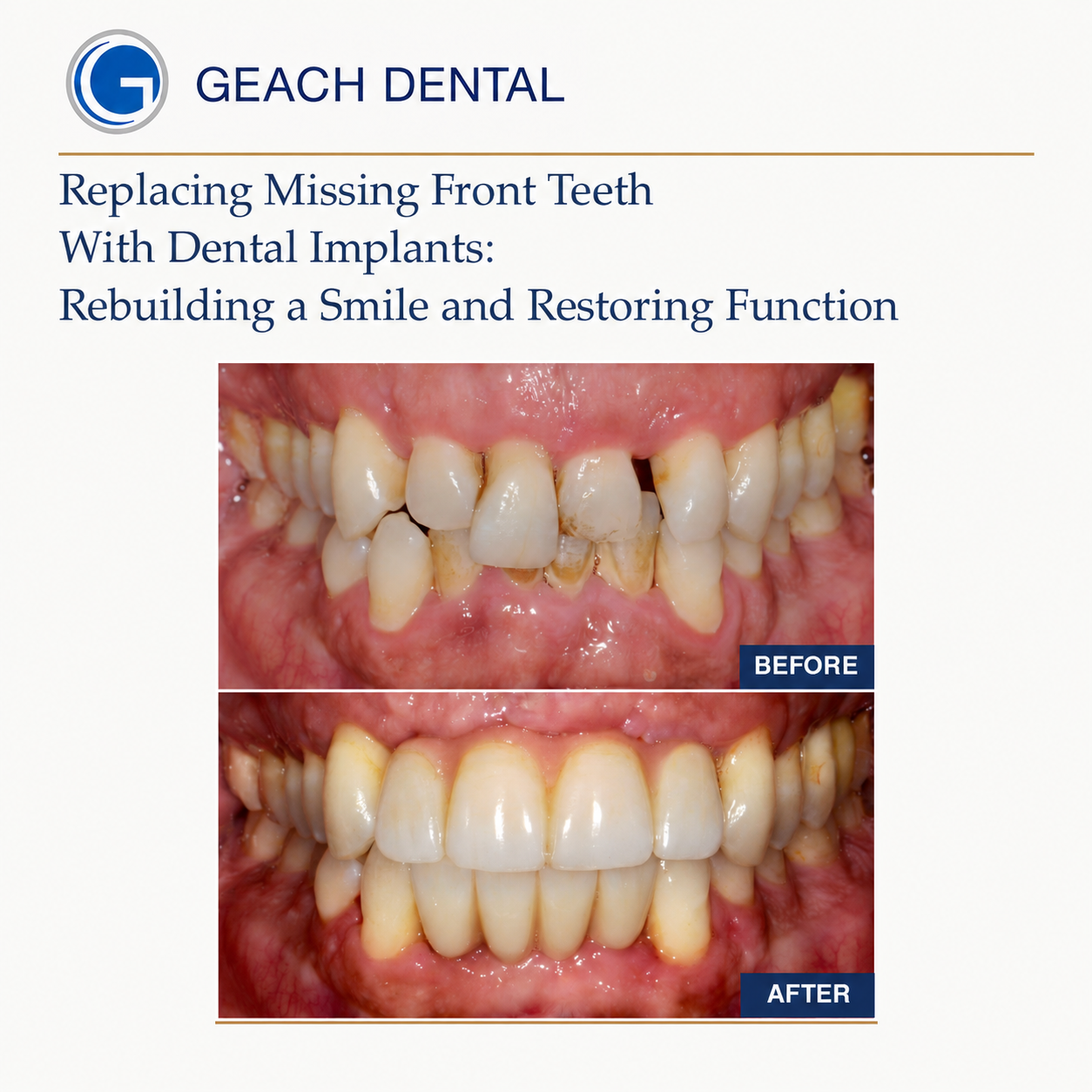
A comprehensive evaluation revealed severe periodontal bone loss affecting both the upper and lower four front teeth. Over time, the upper teeth had shifted dramatically, changing his smile and compromising their position.
The goal was bigger than replacing missing teeth.
We wanted to rebuild his smile and restore his ability to function comfortably again.
Why Couldn’t the Front Teeth Be Saved?
The foundation of a healthy tooth is the bone and gum tissue surrounding it.
When periodontal disease becomes advanced, that supporting bone can be lost. Teeth may become mobile, migrate into different positions, and eventually reach a point where keeping them is no longer predictable.
This patient also reported a long history of cigarette smoking, an important factor considered as part of his periodontal evaluation.
Before beginning the prosthodontic treatment, we referred him to a periodontist for a complete periodontal evaluation.
His treatment plan included periodontal therapy and oral-hygiene instruction, management of his smoking, removal of the eight severely compromised front teeth, placement of dental implants, and fabrication of implant-supported bridges to replace the missing teeth.
Dental Implants Are Only Part of the Solution
When replacing front teeth, successfully placing dental implants is extremely important—but it’s only part of the treatment.
We also have to determine:
Where should the new teeth go?
This patient had lived with teeth that had shifted significantly because of periodontal bone loss. Simply reproducing their existing positions would reproduce many of the same esthetic problems.
Instead, we began by designing the final smile first.
Before treatment, we created a digital blueprint showing the planned position, shape, size, and proportions of the future teeth.
That blueprint helped guide both implant placement and the design of the final implant bridges.
Designing the Smile Before Placing the Final Teeth
Our goals were to create teeth that would:
- Restore a more natural position of the front teeth
- Create attractive proportions and contours
- Complement the patient’s face and smile
- Blend with the surrounding natural teeth
- Restore comfortable biting and function
- Look like teeth rather than dental restorations
This planning is especially important when dental implants are being used in the front of the mouth.
Unlike natural teeth, implants cannot simply be moved after they have integrated into the bone. The final restoration therefore needs to be considered from the beginning of treatment.
Temporary Implant Teeth Let Us Test the New Smile
After the compromised teeth were removed and the implants placed, temporary implant-supported bridges were created from our digital design.
These temporary teeth served an important purpose.
They allowed us to evaluate the new smile before making the final implant bridges.
We could adjust the:
- Length of the teeth
- Shape and proportions
- Position of the teeth
- Relationship with the lips and smile
- Appearance of the gum tissue
Most importantly, the patient could participate.
He could see his new smile, live with it, and give us feedback about the appearance before we fabricated the final restorations. The temporary bridges also allowed the surrounding soft tissue to be shaped and refined during healing.
Creating Natural-Looking Implant Teeth
One of the greatest challenges in implant dentistry is making replacement teeth look natural—particularly in the front of the mouth.
Color is only one part of the equation.
Natural-looking teeth depend on subtle differences in shape, proportion, translucency, surface texture, and contours.
At Geach Dental, we have the advantage of working closely with our in-office laboratory technician. For complex implant cases, the technician can meet directly with the patient and work with Dr. Geach to refine shade, shape, contours, and other details before the final restorations are completed.
The objective is simple:
People should see your smile—not your dental implants.
The Final Result: A New Smile and Restored Function
The before-and-after photographs tell an important story.
In the original photographs, the severe movement of the front teeth is immediately noticeable. In the final photographs, the upper and lower implant bridges restore a much more harmonious tooth position and smile.
But this treatment wasn’t performed for appearance alone.
The final implant-supported bridges also restored the patient’s front teeth so that they could once again contribute to normal function.
The definitive restorations were fabricated from zirconia, a tooth-colored ceramic material selected for its combination of esthetics, smooth surface, and durability.
The result is a dramatic change from where this patient began: fixed replacement teeth designed to restore both his smile and his ability to function.
Can Dental Implants Replace Several Missing Front Teeth?
Yes. Dental implants don’t necessarily require one implant for every missing tooth.
In appropriate situations, strategically positioned implants can support a fixed dental bridge that replaces several missing teeth.
This can be particularly useful for patients who are facing the loss of multiple teeth because of:
- Advanced periodontal disease
- Severe bone loss
- Failing bridges
- Broken or non-restorable teeth
- Dental trauma
- Multiple missing teeth
The appropriate number and position of implants depends on each patient’s bone, gum tissue, bite, remaining teeth, health history, and restorative goals.
That’s why careful planning before implant placement is so important.
Why Choose a Prosthodontist for Complex Dental Implant Treatment?
Replacing several missing front teeth requires more than placing implants.
The final teeth need to look natural, fit the patient’s face, function with the bite, and integrate with the remaining natural teeth.
A prosthodontist receives advanced specialty training in replacing and reconstructing teeth, including complex dental implant treatment.
At Geach Dental, our approach combines prosthodontic planning, digital smile design, implant dentistry, provisional restorations, and close collaboration with our in-office dental laboratory.
For complex cases, we also coordinate treatment with periodontal and other dental specialists when appropriate.
The objective isn’t simply to replace missing teeth. It’s to reconstruct the smile as a whole.
Considering Dental Implants in Los Angeles?
If you have missing teeth—or have been told that several teeth can no longer be saved—you may have more options than you realize.
Dental implants can often be used to replace multiple failing or missing teeth with fixed restorations designed to restore both appearance and function.
Dr. Adam Geach, DMD, MDSc, is a prosthodontist at Geach Dental in Downtown Los Angeles, providing advanced dental implant, restorative, and reconstructive dentistry.
If you are considering dental implants to replace missing or failing teeth, schedule a consultation to learn what treatment options may be appropriate for you.
Geach Dental
Downtown Los Angeles
(213) 622-3339