
Geach Dental

Case Study: A Prosthodontist Restores A Damaged Smile

Case Study: A Prosthodontist Restores A Damaged Smile

As a prosthodontist, my primary goal is to restore teeth using prosthetics, focusing on achieving both functional and aesthetically pleasing results. In my daily practice in downtown Los Angeles, I work on a range of cases that require the precise design and implementation of dental restorations. Today, I invite you to join me in exploring a recent case that exemplifies the core of my profession.

Prosthodontics is the art and science of rebuilding smiles, and my role often involves collaborating with other dental specialists to provide comprehensive care to our patients. This case offers a glimpse into prosthodontics, shedding light on the steps, techniques, and considerations that go into restoring a patient’s dental health and confidence.

In the following case study, I’ll walk you through this typical case, highlighting the intricacies of my work and, ultimately, demonstrating how prosthodontics can make a significant difference in the lives of those seeking to regain their dental function and radiant smile.

undefined

The Problem

The patient’s initial presentation was relatively common in prosthodontic practice, but it highlighted a significant issue. They sought my expertise with a concern: two chipped porcelain veneers on their upper front teeth. However, upon closer examination, it became apparent that the problem extended beyond the veneers. See figure 1. 

undefined

The gum tissue adjacent to these veneers appeared red and inflamed, signaling potential underlying issues. To get a comprehensive view of the situation, I decided to remove the veneers and perform a thorough examination. What I discovered was contamination within the root canals of the affected teeth.

The root canals, situated in the innermost part of a tooth, contain the nerve and pulp. In this case the canals had already been previously filled, but were contaminated with bacteria. It is critical that the canals are clean and sealed before proceeding to the final restoration.

The Solution

Before we could restore the patient’s teeth with new restorations, a crucial step was to collaborate with a respected endodontist who also practices in downtown Los Angeles.

An endodontist is a dentist who specializes in treating problems related to tooth pulp. In this case, their expertise was invaluable. The endodontist performed a meticulous retreatment of the patient’s root canals. This procedure involved removing the old root canal fillings, disinfecting and sealing the canals with a new biocompatible material. This helps to prevent future infections and ensures a healthy foundation for the new restorations. 

After the canals were retreated, I then carefully created the necessary space within the canals to accommodate new custom posts. These posts are casted by my laboratory technician in gold alloy. Figure 3 shows the X-rays during the treatment. The X-ray on the left shows the pre-treatment image of the root canals and the chipped veneers. The middle X-ray shows the re-treatment of the canals with space created for the posts. The X-ray on the right shows the gold posts cemented into the canals. 

undefined

Figures 4 shows the red acrylic pattern made for the posts. Figure 5 shows the custom gold posts in position after casting by the laboratory. These posts are retained by the canals and are critical for stabilizing the new crowns. 

This cooperation between myself as the prosthodontist, the endodontist and the laboratory technician illustrates a fundamental aspect of our roles. As prosthodontists, we often serve as the “quarterback” of a patient’s dental team. We chart the course of treatment, coordinating procedures with specialists to optimize the patient’s oral health and deliver the best possible outcome. 

undefined

The End Result

The culmination of this comprehensive treatment was nothing short of stunning, as depicted in these final photographs. The transformation is not only remarkable but also profoundly gratifying for both the patient and our dental team.

One key aspect contributing to the aesthetic success of the treatment is the meticulous design of the crowns. See figure 6 below. They were crafted with precision, with particular attention given to blocking the gold color of the underlying support posts. This attention to detail ensured the teeth did not appear unnaturally dark or discolored. Instead, the crowns seamlessly blend with the surrounding natural teeth, achieving a harmonious and visually pleasing result.

undefined

The porcelain layer meticulously applied over the zirconia crowns plays a pivotal role in mimicking the light-reflecting qualities of natural tooth enamel. This characteristic is crucial in achieving a result that not only looks natural but also exudes the radiance and vitality of a genuine smile. See figures 7 and 8 below.

With this successful treatment, the patient has regained more than just their dental function; they have reclaimed their confidence and a beautiful smile. The ability to comfortably enjoy everyday activities, from speaking and chewing to sharing a confident smile, is a testament to the transformative power of prosthodontics.

undefined

Could You Benefit from a Visit to a Prosthodontist?

If you’ve been inspired by this case and the transformative power of prosthodontics and wish to explore how it can restore your smile, we encourage you to connect with our dedicated team at Geach Dental. With locations in downtown Los Angeles and Laguna Niguel in Orange County, we are ready to provide personalized solutions tailored to your needs. 

Don’t let dental concerns hold you back from a confident, radiant smile! Reach out to us, and let’s embark on a journey to rediscover your best smile. 

Your path to dental health and renewed confidence begins with a simple conversation. Contact us today at (213) 622-3339, or click here and take the first step towards your dental transformation.

ABOUT THE AUTHOR: Meet Dr. Adam Geach, distinguished prosthodontics specialist and owner of Geach Dental. His dental education includes Harvard School of Dental Medicine and the University of Connecticut, where he earned a D.M.D. and an M.D.Sc. in Prosthodontics, respectively. Dr. Geach holds Diplomate status with the American Board of Prosthodontics, underscoring his exceptional expertise in dental care. 

At his clinics in Los Angeles and Laguna Niguel, Dr. Geach offers a wide range of services, from cosmetic treatments to full-mouth reconstructions, all delivered with a focus on personalized patient care.Take the first step toward your ideal smile and improved oral health by clicking here.

Search for Blog Articles

Pinteresting Board
Share

Meet Dr. Adam Geach, distinguished prosthodontics specialist and owner ofย  Geach Dental.ย 

His dental education includes Harvard School of Dental Medicine and the University of Connecticut, where he earned a D.M.D. and an M.D.Sc. in Prosthodontics, respectively. Dr. Geach holds Diplomate status with the American Board of Prosthodontics, underscoring his exceptional expertise in dental care.ย At his clinics in Los Angeles and Laguna Niguel, Dr. Geach offers a wide range of services, from cosmetic treatments to full-mouth reconstructions, all delivered with a focus on personalized patient care.Take the first step toward your ideal smile and improved oral health by clicking here.
Related blog posts

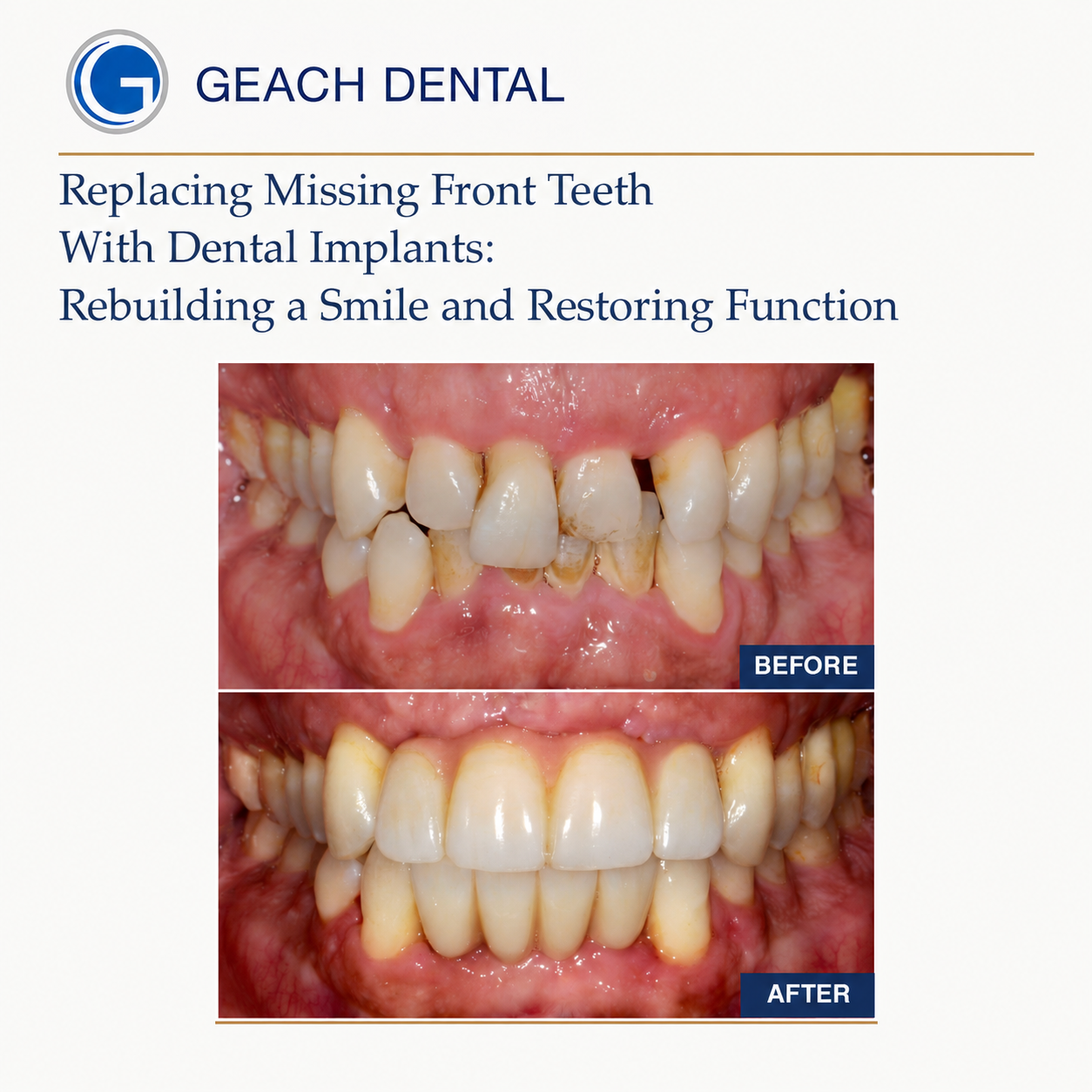
Replacing missing front teeth with dental implants

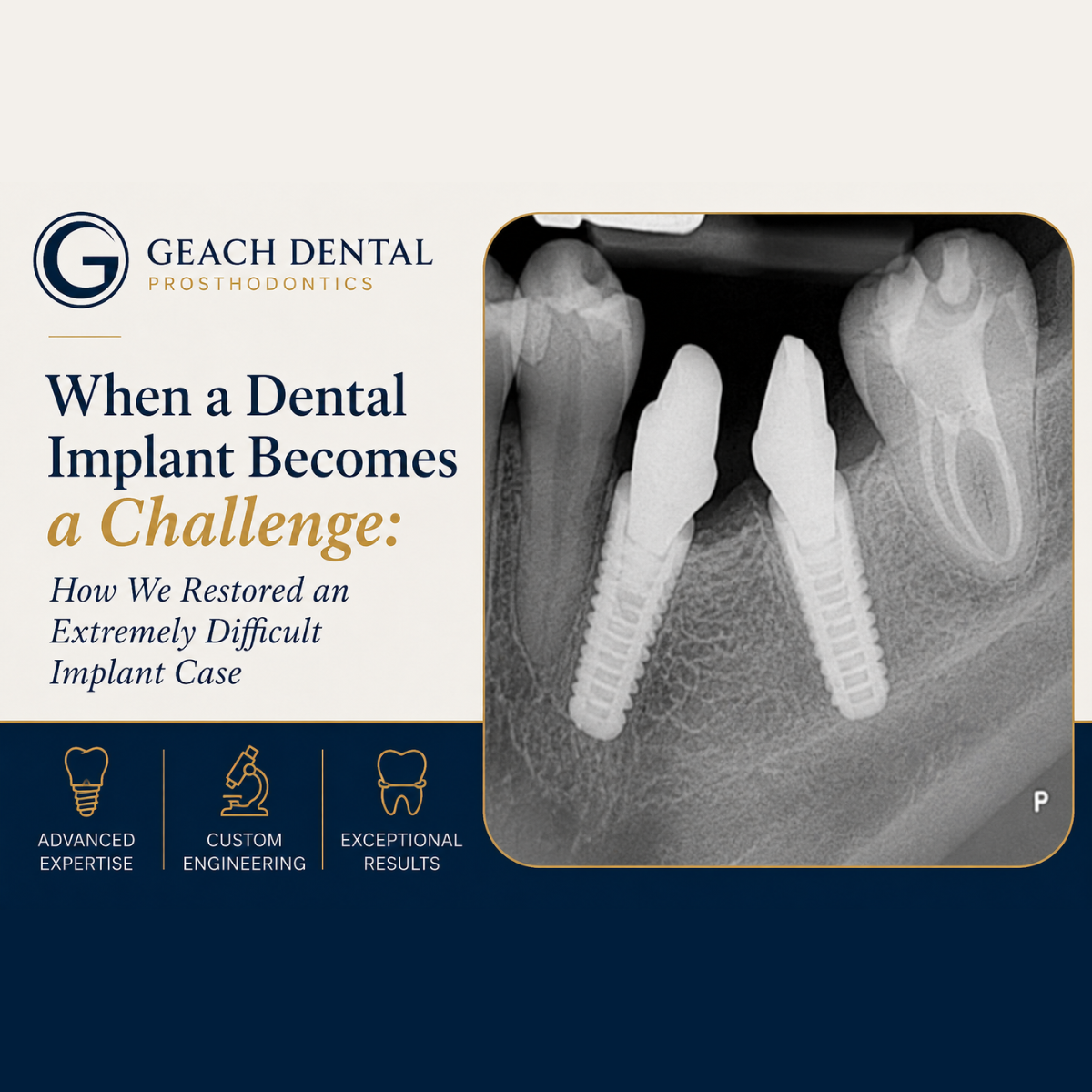
How Dental Implants Can Replace Failing Teeth and Create a Natural-Looking, Functional Smile Losing your front teethโ€”or being told they can no longer be savedโ€”can be overwhelming. Front teeth aren’t only important for your smile. They help you bite into foods, speak clearly, and feel comfortable smiling and interacting with other people. For patients with advanced gum disease, teeth can gradually lose their supporting bone, become loose, and move out of their natural positions. Eventually, saving those teeth may no longer be predictable. That was the situation for this patient. He came to Geach Dental in Los Angeles extremely self-conscious about his front teeth. He had become so uncomfortable with their appearance that he avoided smiling. But his problem wasn’t only cosmetic. A comprehensive evaluation revealed severe periodontal bone loss affecting both the upper and lower four front teeth. Over time, the upper teeth had shifted dramatically, changing his smile and compromising their position. The goal was bigger than replacing missing teeth. We wanted to rebuild his smile and restore his ability to function comfortably again. Why Couldnโ€™t the Front Teeth Be Saved? The foundation of a healthy tooth is the bone and gum tissue surrounding it. When periodontal disease becomes advanced, that supporting bone can be lost. Teeth may become mobile, migrate into different positions, and eventually reach a point where keeping them is no longer predictable. This patient also reported a long history of cigarette smoking, an important factor considered as part of his periodontal evaluation. Before beginning the prosthodontic treatment, we referred him to a periodontist for a complete periodontal evaluation. His treatment plan included periodontal therapy and oral-hygiene instruction, management of his smoking, removal of the eight severely compromised front teeth, placement of dental implants, and fabrication of implant-supported bridges to replace the missing teeth. Dental Implants Are Only Part of the Solution When replacing front teeth, successfully placing dental implants is extremely importantโ€”but it’s only part of the treatment. We also have to determine: Where should the new teeth go? This patient had lived with teeth that had shifted significantly because of periodontal bone loss. Simply reproducing their existing positions would reproduce many of the same esthetic problems. Instead, we began by designing the final smile first. Before treatment, we created a digital blueprint showing the planned position, shape, size, and proportions of the future teeth. That blueprint helped guide both implant placement and the design of the final implant bridges. Designing the Smile Before Placing the Final Teeth Our goals were to create teeth that would: This planning is especially important when dental implants are being used in the front of the mouth. Unlike natural teeth, implants cannot simply be moved after they have integrated into the bone. The final restoration therefore needs to be considered from the beginning of treatment. Temporary Implant Teeth Let Us Test the New Smile After the compromised teeth were removed and the implants placed, temporary implant-supported bridges were created from our digital design. These temporary teeth served an important purpose. They allowed us to evaluate the new smile before making the final implant bridges. We could adjust the: Most importantly, the patient could participate. He could see his new smile, live with it, and give us feedback about the appearance before we fabricated the final restorations. The temporary bridges also allowed the surrounding soft tissue to be shaped and refined during healing. Creating Natural-Looking Implant Teeth One of the greatest challenges in implant dentistry is making replacement teeth look naturalโ€”particularly in the front of the mouth. Color is only one part of the equation. Natural-looking teeth depend on subtle differences in shape, proportion, translucency, surface texture, and contours. At Geach Dental, we have the advantage of working closely with our in-office laboratory technician. For complex implant cases, the technician can meet directly with the patient and work with Dr. Geach to refine shade, shape, contours, and other details before the final restorations are completed. The objective is simple: People should see your smileโ€”not your dental implants. The Final Result: A New Smile and Restored Function The before-and-after photographs tell an important story. In the original photographs, the severe movement of the front teeth is immediately noticeable. In the final photographs, the upper and lower implant bridges restore a much more harmonious tooth position and smile. But this treatment wasn’t performed for appearance alone. The final implant-supported bridges also restored the patient’s front teeth so that they could once again contribute to normal function. The definitive restorations were fabricated from zirconia, a tooth-colored ceramic material selected for its combination of esthetics, smooth surface, and durability. The result is a dramatic change from where this patient began: fixed replacement teeth designed to restore both his smile and his ability to function. Can Dental Implants Replace Several Missing Front Teeth? Yes. Dental implants don’t necessarily require one implant for every missing tooth. In appropriate situations, strategically positioned implants can support a fixed dental bridge that replaces several missing teeth. This can be particularly useful for patients who are facing the loss of multiple teeth because of: The appropriate number and position of implants depends on each patient’s bone, gum tissue, bite, remaining teeth, health history, and restorative goals. That’s why careful planning before implant placement is so important. Why Choose a Prosthodontist for Complex Dental Implant Treatment? Replacing several missing front teeth requires more than placing implants. The final teeth need to look natural, fit the patient’s face, function with the bite, and integrate with the remaining natural teeth. A prosthodontist receives advanced specialty training in replacing and reconstructing teeth, including complex dental implant treatment. At Geach Dental, our approach combines prosthodontic planning, digital smile design, implant dentistry, provisional restorations, and close collaboration with our in-office dental laboratory. For complex cases, we also coordinate treatment with periodontal and other dental specialists when appropriate. The objective isn’t simply to replace missing teeth. It’s to reconstruct the smile as a whole. Considering Dental Implants in Los Angeles? If you have missing teethโ€”or

Read Up

When Old Veneers Make Your Smile Look Older

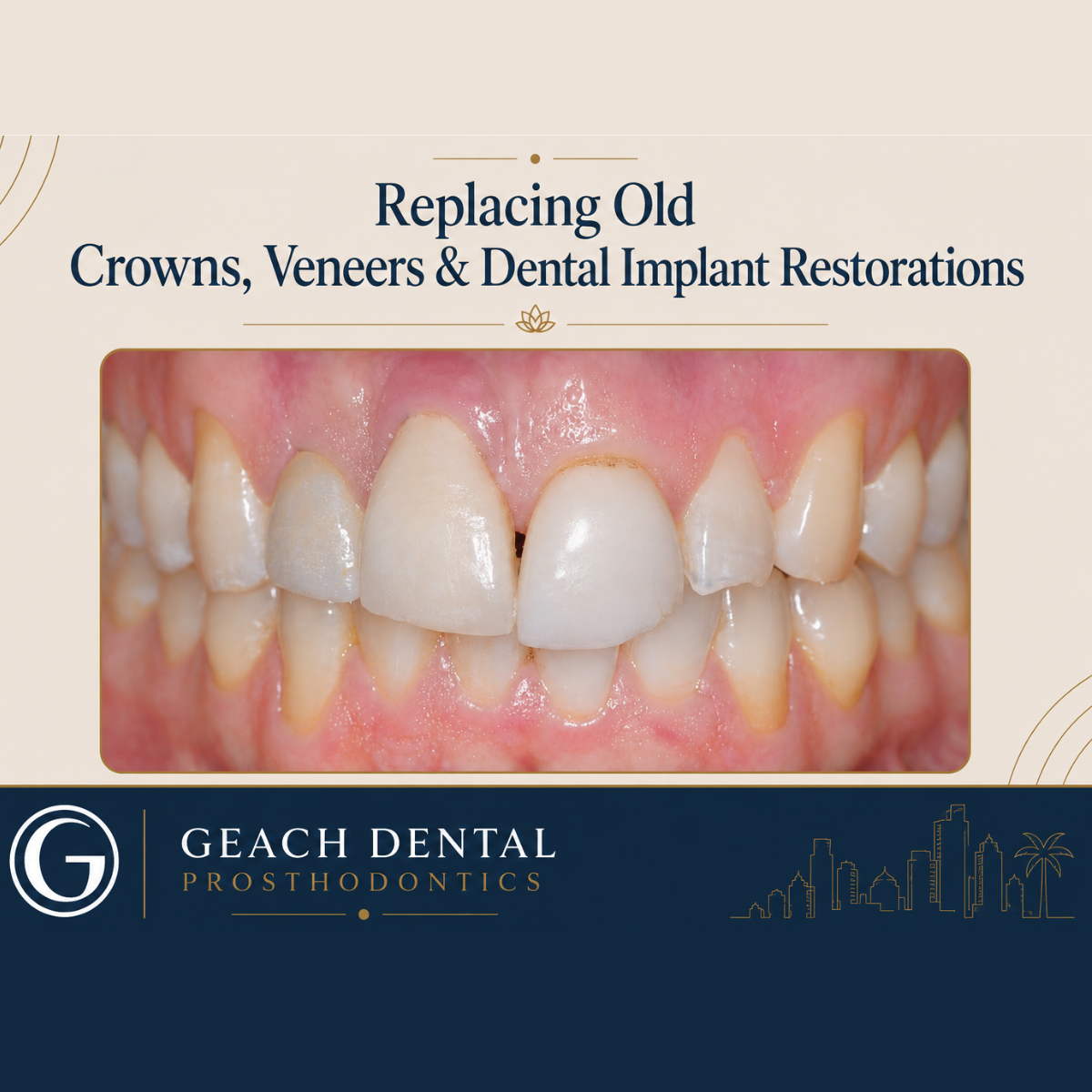
A Prosthodontic Approach to Replacing Aging Cosmetic Dentistry with Natural-Looking Restorations If you had veneers or crowns placed 10, 15, or even 20 years ago, you may have loved your smile when they were first completed. But smiles changeโ€”and so does cosmetic dentistry. Older veneers can look bulky, square, opaque, worn, or simply outdated compared with today’s more natural-looking ceramic restorations. Sometimes patients don’t want an entirely new smile. They just want their smile to look natural again. That was the goal for this patient. The Problem: Old Veneers That No Longer Looked Natural This patient was referred to Geach Dental because she was unhappy with the appearance of her four upper front teeth. Her existing veneers had several characteristics that made them stand out from her surrounding natural teeth. The front teeth appeared very square, all four restorations slanted slightly to one side, and the porcelain was relatively opaque rather than having the subtle translucency of natural enamel. See picture below.  The veneers weren’t simply “old.” They looked like dental work. Our goal was to change that. We wanted to replace the aging restorations with teeth that blended naturally into her smileโ€”without creating an artificial or overly perfect appearance. Good Cosmetic Dentistry Shouldn’t Look Like Dental Work One of the misconceptions about cosmetic dentistry is that improving a smile simply means making teeth whiter. For us, natural-looking cosmetic dentistry is much more about the details. The shape, proportions, contours, translucency, alignment, and color of the teeth all need to work together. For this patient, our goals were to: Ultimately, people should notice your smileโ€”not your dental work. Designing the New Smile Before Making the Final Teeth Before fabricating the final restorations, we created a digital diagnostic design for the four front teeth. This allowed us to establish the new tooth shapes and proportions before completing the final crowns. After removing the existing veneers, the teeth were conservatively prepared and custom temporary crowns were made from our new digital design. This is an important part of our approach to complex cosmetic dentistry. Rather than simply removing the old restorations and hoping the patient likes the final result, the temporary crowns allow us to test-drive the new smile first. The Patient Gets a Say in the Final Smile With the temporary restorations in place, the patient can see the proposed changes directly in her own mouth. We can evaluate: Most importantly, the patient can give us feedback. If we want a tooth slightly shorter, longer, softer, or more rounded, those changes can be made before the final restorations are fabricated. Once the temporary restorations look and feel right, they become the blueprint for the final teeth. That patient feedback and refinement process was an important part of this case. Why Replacing Only Four Front Teeth Can Be So Challenging You might assume that replacing four veneers is easier than restoring an entire smile. Esthetically, the opposite can sometimes be true. When we replace only a few front teeth, the new restorations must blend with the patient’s remaining natural teeth. The shade can’t simply be “white.” Natural teeth have subtle variations in color, translucency, texture, and brightness. Reproducing those characteristics is what helps a ceramic restoration look like a tooth rather than a crown. The goal is not to make four beautiful crowns. The goal is to make it difficult to tell which four teeth are crowns. The Advantage of Our In-Office Dental Laboratory At Geach Dental, we work closely with our in-office laboratory technician when creating highly esthetic restorations. This allows us to carefully control details such as: In this case, the final restorations were designed, milled, characterized, and finished in close collaboration with our technician, using the refined temporary crowns as the guide for the final result. For front teeth, these small details can make an enormous difference. The Result: A More Natural-Looking Smile The objective wasn’t to give this patient a completely different smile. It was to make her existing smile look more natural, balanced, and current. The new front teeth have softer contours, improved alignment, and a more natural relationship with the surrounding teeth. The final crowns were made from zirconia, selected to provide a combination of esthetics and durability. The improvement is noticeable. But ideally, the dentistry isn’t. That’s exactly what we want. Before After Is It Time to Replace Your Old Veneers or Crowns? Many patients assume they should only replace veneers or crowns when something breaks. That’s not necessarily the case. You may want to consider replacing older cosmetic dental work if your restorations have become: You may also simply feel that your dental work makes your smile look older than you feel. In some cases, replacing just a few aging restorations can refresh the appearance of the entire smile. Why See a Prosthodontist for Replacing Old Dental Work? Replacing existing cosmetic dentistry presents different challenges than starting with untouched teeth. The dentist needs to evaluate the existing restorations, the teeth underneath them, the bite, the surrounding natural teeth, and the patient’s overall smile before determining what shouldโ€”and just as importantly, what should notโ€”be changed. A prosthodontist receives advanced specialty training in restorative, cosmetic, implant, and reconstructive dentistry. At Geach Dental, we routinely treat patients with existing veneers, crowns, dental implants, and complex restorative dentistry. Our approach isn’t simply about making teeth look prettier. We want the final restorations to look natural, function properly, and integrate with the rest of the patient’s smile. Ready to Update Your Smile? If you had cosmetic dentistry completed years ago and your veneers, crowns, or implant restorations no longer look the way you want, you may not need to start over. Sometimes the right approach is simply to replace aging dental work with modern, natural-looking restorations. Dr. Adam Geach, DMD, MDSc, is a prosthodontist providing advanced cosmetic, restorative, and implant dentistry at Geach Dental, serving patients in Downtown Los Angeles and Orange County. If you’re unhappy with old veneers, crowns, or other cosmetic dental work, schedule a consultation

Read Up

Follow Our Newsletter To Stay Tuned

Sign up to receive exclusive guides & tips on health, fashion, travel, beauty and more!

Follow Our Newsletter To Stay Tuned

Sign up to receive exclusive guides & tips on health, fashion, travel, beauty and more!